#### TL;DR
In this 1950 paper Claude Shannon defined the bluepri...
Other papers by Shannon:
- [Prediction and Entropy of Printed Eng...
Shannon describes as an ideal "wedge" to attack complex tasks requi...
Here Shannon describes the shift from strictly numerical computatio...
Chess is the ideal testbed for mechanized thinking because its rule...
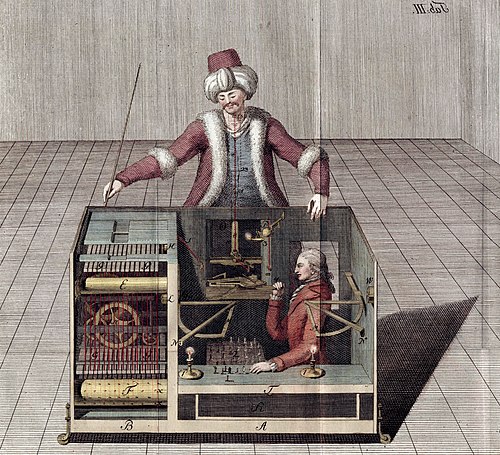
Learn more about the Maelzel Automaton: [Maelzel's Chess Player
](...
Shannon states that chess is a game of perfect information. The ini...
In Nim a simple binary math formula can look at the game and instan...
Shannon introduced a practical estimation formula, $f(P)$. Instead ...
Checkmate is mathematically embedded into the heuristic by giving t...
Shannon realized that scoring a chess board halfway through a strin...
Using the Minimax principle, the computer always expects its oppone...
**'Type A' program** uses exhaustive search, calculating every poss...
Shannon's improved 'Type B' strategy solves the horizon effect by r...
To maximize efficiency, the program employs 'forward pruning' throu...
Shannon proposed an advanced framework in which the computer identi...

Philosophical Magazine, Ser.7, Vol. 41, No. 314 - March 1950.
XXII. Programming a Computer for Playing Chess
1
By CLAUDE E. SHANNON
Bell Telephone Laboratories, Inc., Murray Hill, N.J.
2
[Received November 8, 1949]
1. INTRODUCTION
This paper is concerned with the problem of constructing a computing routine or
"program" for a modern general purpose computer which will enable it to play chess.
Although perhaps of no practical importance, the question is of theoretical interest, and it
is hoped that a satisfactory solution of this problem will act as a wedge in attacking other
problems of a similar nature and of greater significance. Some possibilities in this
direction are: -
(1)Machines for designing filters, equalizers, etc.
(2)Machines for designing relay and switching circuits.
(3)Machines which will handle routing of telephone calls based on the individual
circumstances rather than by fixed patterns.
(4)Machines for performing symbolic (non-numerical) mathematical operations.
(5)Machines capable of translating from one language to another.
(6)Machines for making strategic decisions in simplified military operations.
(7)Machines capable of orchestrating a melody.
(8)Machines capable of logical deduction.
It is believed that all of these and many other devices of a similar nature are possible
developments in the immediate future. The techniques developed for modern electronic
and relay type computers make them not only theoretical possibilities, but in several cases
worthy of serious consideration from the economic point of view.
Machines of this general type are an extension over the ordinary use of numerical
computers in several ways. First, the entities dealt with are not primarily numbers, but
rather chess positions, circuits, mathematical expressions, words, etc. Second, the proper
procedure involves general principles, something of the nature of judgement, and
considerable trial and error, rather than a strict, unalterable computing process. Finally, the
solutions of these problems are not merely right or wrong but have a continuous range of
"quality" from the best down to the worst. We might be satisfied with a machine that
designed good filters even though they were not always the best possible.
1 First presented at the National IRE Convention, March 9, 1949, NewYork, U.S.A.
2 Communicated by the Author
The chess machine is an ideal one to start with, since: (1) the problem is sharply defined
both in allowed operations (the moves) and in the ultimate goal (checkmate); (2) it is
neither so simple as to be trivial nor too difficult for satisfactory solution; (3) chess is
generally considered to require "thinking" for skilful play; a solution of this problem will
force us either to admit the possibility of a mechanized thinking or to further restrict our
concept of "thinking"; (4) the discrete structure of chess fits well into the digital nature of
modern computers.
There is already a considerable literature on the subject of chess-playing machines. During
the late 19th century, the Maelzel Chess Automaton, a device invented by Von Kempelen,
was exhibited widely as a chess-playing machine. A number of papers appeared at the
time, including an analytical essay by Edgar Allan Poe (entitled Maelzel's Chess Player)
purporting to explain its operation. Most of the writers concluded, quite correctly, that the
Automaton was operated by a concealed human chess-master; the arguments leading to
this conclusion, however, were frequently fallacious. Poe assumes, for example, that it is
as easy to design a machine which will invariably win as one which wins occasionally, and
argues that since the Automaton was not invincible it was therefore operated by a human,
a clear 'non sequitur'. For a complete account of the history of the method of operation of
the Automaton, the reader is referred to a series of articles by Harkness and Battell in
Chess Review, 1947.
A more honest attempt to design a chess-playing machine was made in 1914 by Torres y
Quevedo, who constructed a device which played an end game of king and rook against
king (Vigneron, 1914). The machine played the side with king and rook and would force
checkmate in few moves however its human opponent played. Since an explicit set of
rules can be given for making satisfactory moves in such an end game, the problem is
relatively simple, but the idea was quite advanced for that period.
The thesis we will develop is that modern general purpose computers can be used to play a
tolerably good game of chess by the use of suitable computing routine or "program".
White the approach given here is believed fundamentally sound, it will be evident that
much further experimental and theoretical work remains to be done.
2. GENERAL CONSIDERATIONS
A chess "position" may be defined to include the following data: -
(1)A statement of the positions of all pieces on the board.
(2)A statement of which side, White or Black, has the move.
(3)A statement as to whether the king and rooks have moved. This is important
since by moving a rook, for example, the right to castle of that side is forfeited.
(4)A statement of, say, the last move. This will determine whether a possible en
passant capture is legal, since this privilege if forfeited after one move.
(5)A statement of the number of moves made since the last pawn move or capture.
This is important because of the 50 move drawing rule.
For simplicity, we will ignore the rule of draw after three repetitions of a position.
In chess there is no chance element apart from the original choice of which player has the
first move. This is in contrast with card games, backgammon, etc. Furthermore, in chess
each of the two opponents has "perfect information" at each move as to all previous moves
(in contrast with Kriegspiel, for example). These two facts imply (von Neumann and
Morgenstern, 1944) that any given position of the chess pieces must be either: -
(1)A won position for White. That is, White can force a win, however Black
defends.
(2)A draw position. White can force at least a draw, however Black plays, and
likewise Black can force at least a draw, however White plays. If both sides play
correctly the game will end in a draw.
(3)A won position for Black. Black can force a win, however White plays.
This is, for practical purposes, of the nature of an existence theorem. No practical method
is known for determining to which of the three categories a general position belongs. If
there were chess would lose most of its interest as a game. One could determine whether
the initial position is a won, drawn, or lost for White and the outcome of a game between
opponents knowing the method would be fully determined at the choice of the first move.
Supposing the initial position a draw (as suggested by empirical evidence from master
games [1]) every game would end in a draw.
It is interesting that a slight change in the rules of chess gives a game for which it is
provable that White has at least a draw in the initial position. Suppose the rules the same
as those of chess except that a player is not forced to move a piece at his turn to play, but
may, if he chooses, "pass". Then we can prove as a theorem that White can at least draw
by proper play. For in the initial position either he has a winning move or not. If so, let
him make this move. If not, let him pass. Black is not faced with essentially the same
position that White has before, because of the mirror symmetry of the initial position [2].
Since White had no winning move before, Black has none now. Hence, Black at best can
draw. Therefore, in either case White can at least draw.
In some games there is a simple evaluation function f(P) which can be applied to a
position P and whose value determines to which category (won, lost, etc.) the position P
belongs. In the game of Nim (Hardy and Wright, 1938), for example, this can be
determined by writing the number of matches in each pile in binary notation. These
numbers are arranged in a column (as though to add them). If the number of ones in each
column is even, the position is lost for the player about to move, otherwise won.
If such an evaluation function f(P) can be found for a game is easy to design a machine
capable of perfect play. It would never lose or draw a won position and never lose a drawn
position and if the opponent ever made a mistake the machine would capitalize on it. This
could be done as follows.
Suppose:
f(P) = +1 for a won position,
f(P) = 0 for a drawn position,
f(P) = -1 for a lost position.
At the machine's turn to move it calculates f(P) for the various positions obtained from the
present position by each possible move that can be made.
It chooses that move (or one of the set) giving the maximum value to f. In the case of Nim
where such a function f(P) is known, a machine has actually been constructed which plays
a perfect game [3].
With chess it is possible, in principle, to play a perfect game or construct a machine to do
so as follows: One considers in a given position all possible moves, then all moves for the
opponent, etc., to the end of the game (in each variation). The end must occur, by the rules
of the games after a finite number of moves [4] (remembering the 50 move drawing rule).
Each of these variations ends in win, loss or draw. By working backward from the end one
can determine whether there is a forced win, the position is a draw or is lost. It is easy to
show, however, even with the high computing speed available in electronic calculators this
computation is impractical. In typical chess positions there will be of the order of 30 legal
moves. The number holds fairly constant until the game is nearly finished as shown in fig.
1. This graph was constructed from data given by De Groot, who averaged the number of
legal moves in a large number of master games (De Groot, 1946, a). Thus a move for
White and then one for Black gives about 10
3
possibilities. A typical game lasts about 40
moves to resignation of one party. This is conservative for our calculation since the
machine would calculate out to checkmate, not resignation.
However, even at this figure there will be 10
120
variations to be calculated from the initial
position. A machine operating at the rate of one variation per micro-second would require
over 10
90
years to calculate the first move!
Another (equally impractical) method is to have a "dictionary" of all possible positions of
the chess pieces. For each possible position there is an entry giving the correct move
(either calculated by the above process or supplied by a chess master.) At the machine's
turn to move it merely looks up the position and makes the indicated move. The number of
possible positions, of the general order of 64! / 32!(8!)
2
(2!)
6
, or roughly 10
43
, naturally
makes such a design unfeasible.
It is clear then that the problem is not that of designing a machine to play perfect chess
(which is quite impractical) nor one which merely plays legal chess (which is trivial). We
would like to play a skilful game, perhaps comparable to that of a good human player.
A strategy for chess may be described as a process for choosing a move in any given
position. If the process always chooses the same move in the same position the strategy is
known in the theory of games as a "pure" strategy. If the process involves statistical
elements and does not always result in the same choice it is a "mixed" strategy. The
following are simple examples of strategies: -
(1)Number the possible legal moves in the position P, according to some standard
procedure. Choose the first on the list. This is a pure strategy.
(2)Number the legal moves and choose one at random from the list. This is a
mixed strategy.
Both, of course, are extremely poor strategies, making no attempt to select good moves.
Our problem is to develop a tolerably good strategy for selecting the move to be made.
3. APPROXIMATE EVALUATING FUNCTIONS
Although in chess there is no known simple and exact evaluating function f(P), and
probably never will be because of the arbitrary and complicated nature of the rules of the
game, it is still possible to perform an approximate evaluation of a position. Any good
chess player must, in fact, be able to perform such a position evaluation. Evaluations are
based on the general structure of the position, the number and kind of Black and White
pieces, pawn formation, mobility, etc. These evaluations are not perfect, but the stronger
the player the better his evaluations.
Most of the maxims and principles of correct play are really assertions about evaluating
positions, for example: -
(1)The relative values of queen, rook, bishop, knight and pawn are about 9, 5, 3, 3,
1, respectively. Thus other things being equal (!) if we add the numbers of
pieces for the two sides with these coefficients, the side with the largest total
has the better position.
(2)Rooks should be placed on open files. This is part of a more general principle
that the side with the greater mobility, other things equal, has the better game.
(3)Backward, isolated and doubled pawns are weak.
(4)An exposed king is a weakness (until the end game).
These and similar principles are only generalizations from empirical evidence of numerous
games, and only have a kind of statistical validity. Probably any chess principle can be
contradicted by particular counter examples. However, form these principles one can
construct a crude evaluation function. The following is an example: -
f(P) = 200(K-K') + 9(Q-Q') + 5(R-R') + 3(B-B'+N-N') + (P-P') -
0.5(D-D'+S-S'+I-I') +
0.1(M-M') + ...
in which: -
(1)K,Q,R,B,B,P are the number of White kings, queens, rooks, bishops, knights
and pawns on the board.
(2)D,S,I are doubled, backward and isolated White pawns.
(3)M= White mobility (measured, say, as the number of legal moves available to
White).
Primed letters are the similar quantities for Black.
The coefficients 0.5 and 0.1 are merely the writer's rough estimate. Furthermore, there are
many other terms that should be included [5]. The formula is given only for illustrative
purposes. Checkmate has been artificially included here by giving the king the large value
200 (anything greater than the maximum of all other terms would do).
It may be noted that this approximate evaluation f(P) has a more or less continuous range
of possible values, while with an exact evaluation there are only three possible values.
This is as it should be. In practical play a position may be an "easy win" if a player is, for
example, a queen ahead, or a very difficult win with only a pawn advantage.
The unlimited intellect assumed in the theory of games, on the other hand, never make a
mistake and a smallest winning advantage is as good as mate in one. A game between two
such mental giants, Mr. A and Mr. B, would proceed as follows. They sit down at the
chessboard, draw the colours, and then survey the pieces for a moment. Then either: -
(1)Mr. A says, "I resign" or
(2)Mr. B says, "I resign" or
(3)Mr. A says, "I offer a draw," and Mr. B replies, "I accept."
4. STRATEGY BASED ON AN EVALUATION FUNCTION
A very important point about the simple type of evaluation function given above (and
general principles of chess) is that they can only be applied in relatively quiescent
positions. For example, in an exchange of queens White plays, say, QxQ (x=captures) and
Black will reply while White is, for a moment, a queen ahead, since Black will
immediately recover it. More generally it is meaningless to calculate an evaluation
function of the general type given above during the course of a combination or a series of
exchanges.
More terms could be added to f(P) to account for exchanges in progress, but it appears that
combinations, and forced variations in general, are better accounted for by examination of
specific variations. This is, in fact, the way chess players calculate. A certain number of
variations are investigated move by move until a more or less quiescent position is reached
and at this point something of the nature of an evaluation is applied to the resulting
position. The player chooses the variation leading to the highest evaluation for him when
the opponent is assumed to be playing to reduce this evaluation.
The process can be described mathematically. We omit at first the fact that f(P) should be
only applied in quiescent positions. A strategy of play based on f(P) and operating one
move deep is the following. Let M
1
, M
2
, M
3
, ..., M
s
be the moves that can be made in
position P and let M
1
P, M
2
P, etc. denote symbolically the resulting positions when M
1
, M
2
,
etc. are applied to P. Then one chooses the M
m
which maximizes f(M
m
P).
A deeper strategy would consider the opponent's replies. Let M
i1
, M
i2
, ..., M
is
be the
possible answers by Black, if White chooses move M
i
. Black should play to minimize f(P).
Furthermore, his choice occurs after White's move. Thus, if White plays M
i
Black may be
assumed to play the M
ij
such that
f(M
ij
M
iP
)
is a minimum. White should play his first move such that f is a maximum after Black
chooses his best reply. Therefore, White should play to maximize on M
i
the quantity
min f(M
ij
M
iP
)
M
ij
The mathematical process involved is shown for simple case in fig. 2. The point at the left
represents the position being considered. It is assumed that there are three possible moves
for White, indicated by the solid lines, and if any of these is made there are three possible
moves for Black, indicated by the dashed lines. The possible positions after a White and
Black move are then the nine points on the right, and the numbers are the evaluations for
these positions. Minimizing on the upper three gives +1 which is the resulting value if
White chooses the upper variation and Black replies with his best move. Similarly, the
second and third moves lead to values of -7 and -6. Maximizing on White's move, we
obtain +1 with the upper move as White's best choice.
In a similar way a two-move strategy (based on considering all variations out to 2 moves)
is given by
max min max min f(M
ijkl
M
ijk
M
ij
M
iP
) (1)
M
i
M
ij
M
ijk
M
ijkl
The order of maximizing and minimizing this function is important. It derives from the
fact that the choices of moves occur in a definite order.
A machine operating on this strategy at the two-move level would first calculate all
variations out to two moves (for each side) and the resulting positions. The evaluations f
(P) are calculated for each of these positions. Fixing all but the last Black move, this last is
varied and the move chosen which minimizes f. This is Black's assumed last move in the
variation in question. Another move for White's second move is chosen and the process
repeated for Black's second move. This is done for each second White move and the one
chosen giving the target final f (after Black's best assumed reply in each case). In his way
White's second move in each variation is determined. Continuing in this way the machine
works back to the present position and the best first White move. This move in then
played. This process generalizes in the obvious way for any number of moves.
A strategy of this sort, in which all variations are considered out to a definite number of
moves and the move then determined form a formula such as (1) will be called type A
strategy. The type A strategy has certain basic weaknesses, which we will discuss later, but
is conceptually simple, and we will first show how a computer can be programmed for
such a strategy.
5. PROGRAMMING A GENERAL PURPOSE COMPUTER FOR A TYPE A
STRATEGY
We assume a large-scale digital computer, indicated schematically in Fig. 3, with the
following properties: -
(1)There is a large internal memory for storing numbers. The memory is divided
into a number of boxes each capable of holding, say, a ten-digit number. Each
box is assigned a "box number".
(2)There is an arithmetic organ which can perform the elementary operations of
addition, multiplication, etc.
(3)The computer operates under the control of a "program". The program consists
of a sequence of elementary "orders". A typical order is A 372, 451, 133. This
means, extract the contents of box 372 and of box 451, add these numbers, and
put the sum in box 133. Another type of order involves a decision, for example
C 291, 118, 345. This tells the machine to compare the contents of box 291 and
118. If the first is larger the machine goes on to the next order in the program. If
not, it takes its next order from box 345. This type of order enables the machine
to choose from alternative procedures, depending on the results of previous
calculations. It is assumed that orders are available for transferring numbers, the
arithmetic operations, and decisions.
Our problem is to represent chess as numbers and operations on numbers, and to reduce
the strategy decided upon to a sequence of computer orders. We will not carry this out in
detail but only outline the programs. As a colleague puts it, the final program for a
computer must be written in words of one microsyllable.
The rather Procrustean tactics of forcing chess into an arithmetic computer are dictated by
economic considerations. Ideally, we would like to design a special computer for chess
containing, in place of the arithmetic organ, a "chess organ" specifically designed to
perform the simple chess calculations. Although a large improvement in speed of
operation would undoubtedly result, the initial cost of computers seems to prohibit such a
possibility. It is planned, however, to experiment with a simple strategy on one of the
numerical computers now being constructed.
A game of chess can be divided into three phases, the opening, the middle game, and the
end game. Different principles of play apply in the different phases. In the opening, which
generally lasts for about ten moves, development of the pieces to good positions is the
main objective.
During the middle game tactics and combinations are predominant. This phase lasts until
most of the pieces are exchanged, leaving only kings, pawns and perhaps one or two
pieces on each side. The end game is mainly concerned with pawn promotion. Exact
timing and such possibilities as "Zugzwang", stalemate, etc., become important.
Due to the difference in strategic aims, different programs should be used for the different
phases of a game. We will be chiefly concerned with the middle game and will not
consider the end game at all. There seems no reason, however, why an end game strategy
cannot be designed and programmed equally well.
A square on a chessboard can be occupied in 13 different ways: either it is empty (0) or
occupied by one of the six possible kinds of White pieces (P=1, N=2, B=3, R=4, Q=5,
K=6) or one of the six possible Black pieces (P=-1, N=-2, ..., K=-6). Thus, the state of a
square is specified by giving an integer from -6 to +6. The 64 squares can be numbered
according to a co-ordinate system as shown in Fig. 4. The position of all pieces is then
given by a sequence of 64 numbers each lying between -6 and +6. A total of 256 bits
(binary digits) is sufficient memory in this representation. Although not the most efficient
encoding, it is a convenient one for calculation. One further number lambda will be +1 or
-1 according as it is White's or Black's move. A few more should be added for data
relating to castling privileges (whether the White or Black kings and rooks have moved),
and en passant captures (e.g., a statement of the last move). We will neglect these,
however. In this notation the starting chess position is given by: -
4, 2, 3, 5, 6, 3, 2, 4;
1, 1, 1, 1, 1, 1, 1, 1;
0, 0, 0, 0, 0, 0, 0, 0;
0, 0, 0, 0, 0, 0, 0, 0;
0, 0, 0, 0, 0, 0, 0, 0;
0, 0, 0, 0, 0, 0, 0, 0;
-1, -1, -1, -1, -1, -1, -1, -1;
-4, -2, -3, -5, -6, -3, -2, -4;
+1 (=lambda)
A move (apart from castling and pawn promotion) can be specified by giving the original
and final squares occupied by the moved piece. each of these squares is a choice from 64,
thus 6 binary digits each is sufficient, a total of 12 for the move. Thus the initial move e4
would be represented by 1, 4; 3, 4. To represent pawn promotion on a set of three binary
digits can be added specifying the pieces that the pawn becomes. Castling is described by
the king move (this being the only way the king can move two squares). Thus, a move is
represented by (a, b, c) where a and b are squares and c specifies a piece in case of
promotion.
The complete program for a type A strategy consists on nine subprograms which we
designate T
0
, T
1
, ..., T
8
and a master program T
9
. The basic functions of these programs are
as follows: -
T
0
- Makes move (a, b, c) in position P to obtain the resulting position.
T
1
- Makes a list of the possible moves of a pawn at square (x, y) in position P.
T
2
, ..., T
6
- Similarly for other types of pieces: knight, bishop, rook, queen and
king.
T
7
- Makes list of all possible moves in a given position.
T
8
- Calculates the evaluating function f(P) for a given position P.
T
9
- Master program; performs maximizing and minimizing calculation to
determine proper move.
With a given position P and a move (a, b, c) in the internal memory of the machine it can
make the move and obtain the resulting position by the following program T
0
: -
(1)The square corresponding to number a in the position is located in the position
memory.
(2)The number in this square x is extracted and replaced by 0 (empty).
(3)If x=1, and the first co-ordinate of a is 6 (White pawn being promoted) or if x=-
1 and the first co-ordinate of a is 1 (Black pawn being promoted), the number c
is placed in square b (replacing whatever was there).
If x=6 and a-b=2 (White castles, king side) 0 is placed in squares 04 and 07 and
6 and 4 in squares 06 and 05, respectively. Similarly for the cases x=6, b-a=2
(White castles, queen side) and x=-6, a-b=+-2 (Black castles, king or queen
side).
In all other cases, x is placed in square b.
(4)The sign of lambda is changed.
For each type of piece there is a program for determining its possible moves. As a typical
example the bishop program, T
3
, is briefly as follows. Let (x, y) be the co-ordinates of the
square occupied by the bishop: -
(1)Construct (x+1,y+1) and read the contents u of this square in the position P.
(2)If u=0 (empty) list the move (x, y), (x+1,y+1) and start over with (x+2,y+2)
instead of (x+1,y+1).
If lambda*u is positive (own piece in the square) continue to 3.
If lambda*u is negative (opponent's piece in the square) list the move and
continue to 3.
If the square does not exist continue to 3.
(3)Construct (x+1,y-1) and perform similar calculation.
(4)Similarly with (x-1,y+1).
(5)Similarly with (x-1,y-1).
By this program a list is constructed of the possible moves of a bishop in a given position
P. Similar programs would list the moves of any other piece. There is considerable scope
for opportunism in simplifying these programs; e.g., the queen program, T
5
, can be a
combination of the bishop and rook program, T
3
and T
4
.
Using the piece programs T
1
... T
6
and a controlling program T
7
the machine can construct
a list of all possible moves in any given position P. The controlling program T
7
is briefly
as follows (omitting details): -
(1)Start at square 1,1 and extract contents x.
(2)If lambda*x is positive start corresponding piece program T
x
and when
complete return to (1) adding 1 to square number. If lambda8x is zero or
negative, return to 1 to square number.
(3)Test each of the listed moves for legality and discard those which are illegal.
This is done by making each of the moves in the position P (by program T
0
) and
examining whether it leaves the king in check.
With the programs T
0
.... T
7
it is possible for the machine to play legal chess, merely
making a randomly chosen legal move at each turn to move. The level of play with such a
strategy in unbelievably bad [6].
The writer played a few games against this random strategy and was able to checkmate
generally in four or five moves (by fool's mate, etc.). The following game will illustrate
the utter purposelessness of random play: -
White (random) Black
1. g3 e5
2. d3 Bc5
3. Bd2 Qf6
4. Nc3 Qxf2 mate
We now return to the strategy based on the evaluation f(P). The program T
8
performs the
function of evaluating a position according to the agreed-upon f(P). This can be done by
the obvious means of scanning the squares and adding the terms involved. It is not
difficult to include terms such as doubled pawns, etc.
The final master program T
9
is needed to select the move according to the maximizing and
minimizing process indicated above. On the basis of one move (for each side) T
9
works as
follows: -
(1)List the legal moves (by T
7
) possible in the present position.
(2)Take the first in the list and make this move by T
0
, giving position M
1
P.
(3)List the Black moves in M
1
P.
(4)Apply the first one giving M
11
M
1
P, and evaluate by T
8
.
(5)Apply the second Black move M
12
and evaluate.
(6)Compare, and reject the move with the smaller evaluation.
(7)Continue with the third Black move and compare with the retained value, etc.
(8)When the Black moves are exhausted, one will be retained together with its
evaluation. The process is now repeated with the second White move.
(9)The final evaluation from these two computation are compared and the
maximum retained.
(10)This is continued with all White moves until the best is selected (i.e. the one
remaining after all are tried). This is the move to be made.
These programs are, of course, highly iterative. For that reason they should not require a
great deal of program memory if efficiently worked out.
The internal memory for positions and temporary results of calculations when playing
three moves deep can be estimated. Three positions should probably be remembered: the
initial position, the next to the last, and the last position (now being evaluated). This
requires some 800 bits. Furthermore, there are five lists of moves each requiring about
30x12=360 bits, a total of 1800. Finally, about 200 bits would cover the selections and
evaluations up to the present calculation. Thus, some 3000 bits would suffice.
6. IMPROVEMENTS IN THE STRATEGY
Unfortunately a machine operating according to the type A strategy would be both slow
and a weak player. It would be slow since even if each position were evaluated in one
microsecond (very optimistic) there are about 10
9
evaluations to be made after three
moves (for each side). Thus, more than 16 minutes would be required for a move, or 10
hours for its half of a 40-move game.
It would be weak in playing skill because it is only seeing three moves deep and because
we have not included any condition about quiescent positions for evaluation. The machine
is operating in an extremely inefficient fashion - it computes all variations to exactly three
moves and then stops (even though it or the opponent be in check). A good human player
examines only a few selected variations and carries these out to a reasonable stopping
point. A world champion can construct (at best) combinations say, 15 or 20 moves deep.
Some variations given by Alekhine ("My Best Games of Chess 1924-1937") are of this
length. Of course, only a few variations are explored to any such depth. In amateur play
variations are seldom examined more deeply than six or eight moves, and this only when
the moves are of a highly forcing nature (with very limited possible replies). More
generally, when there are few threats and forceful moves, most calculations are not deeper
than one or two moves, with perhaps half-a-dozen forcing variations explored to three,
four or five moves.
On this point a quotation from Reuben Fine (Fine 1942), a leading American master, is
interesting: "Very often people have the idea that masters foresee everything or nearly
everything; that when they played h3 on the thirteenth move they foresaw that this would
be needed to provide a loophole for the king after the combinations twenty moves later, or
even that when they play 1. e4 they do it with the idea of preventing Nd5 on Black's
twelfth turn, or they feel that everything is mathematically calculated down to the smirk
when the Queen's Rook Pawn queens one move ahead of the opponent's King's Knight's
Pawn. All this is, of course, pure fantasy. The best course to follow is to note the major
consequences for two moves, but try to work out forced variations as they go."
The amount of selection exercised by chess masters in examining possible variations has
been studied experimentally by De Groot (1946, b). He showed various typical positions
to chess masters and asked them to decide on the best move, describing aloud their
analyses of the positions as they thought them through. In this manner the number and
depth of the variations examined could be determined. Fig. 5 shows the result of one such
experiment. In this case the chess master examined sixteen variations, ranging in depth
from 1/2 (one Black move) to 4-1/2 (five Black and four White) moves. The total number
of positions considered was 44.
From these remarks it appears that to improve the speed and strength of play the machine
must: -
(1)Examine forceful variations out as far as possible and evaluate only at
reasonable positions, where some quasi-stability has been established.
(2)Select the variations to be explored by some process so that the machine does
not waste its time in totally pointless variations.
A strategy with these two improvements will be called a type B strategy. It is not difficult
to construct programs incorporating these features.
For the first we define a function g(P) of a position which determines whether
approximate stability exists (no pieces en prise, etc.). A crude definition might be:
g(P) = 1 if any piece is attacked by a piece of lower value or by more
pieces than defences or if any check exists on a square
controlled by the opponent
g(P) = 0 otherwise
Using this function, variations could be explored until g(P)=0, always, however, going at
least two moves and never more, say, 10.
The second improvement would require a function h(P,M) to decide whether a move M in
position P is worth exploring. It is important that this preliminary screening should not
eliminate moves which merely look bad at first sight, for example, a move which puts a
piece en prise; frequently such moves are actually very strong since the piece cannot be
safely taken.
"Always give check, it may be mate" is tongue-in-check advice given to beginners aimed
at their predilection for useless checks. "Always investigate a check, it may lead to mate"
is sound advice for any player.
A check is the most forceful type of move. The opponent's replies are highly limited - he
can never answer by counter attack, for example. This means that a variation starting with
a check can be more readily calculated than any other. Similarly captures, attacks on major
pieces, threats of mate, etc., limit the opponent's replies and should be calculated whether
the move looks good at first sight or not. Hence h(P,M) should be given large values for
all forceful moves (check, captures and attacking moves), for developing moves, medium
values for defensive moves, and low values for other moves. In exploring a variation h
(P,M) would be calculated as the machine computes and would be used to select the
variation considered. As it gets further into the variation the requirements on h are set
higher so that fewer and fewer subvariations are examined. Thus, it would start
considering every first move for itself, only the more forceful replies, etc. By this process
its computing efficiency would be greatly improved.
It is believed that an electronic computer incorporating these two improvements in the
program would play a fairly strong game, at speeds comparable to human speeds. It may
be noted that a machine has several advantages over humans: -
(1)High-speed operations in individual calculations.
(2)Freedom from errors. The only errors will be due to deficiencies of the program
while human players are continually guilty of very simple and obvious blunders.
(3)Freedom from laziness. It is all too easy for a human player to make instinctive
moves without proper analysis of the position.
(4)Freedom from "never". Human players are prone to blunder due to over-
confidence in "won" positions or defeatism and self-recrimination in "lost"
positions.
These must be balanced against the flexibility, imagination and inductive and learning
capacities of the human mind.
Incidentally, the person who designs the program can calculate the move that the machine
will choose in any position, and thus in a sense can play an equally good game. In actual
facts, however, the calculation would be impractical because of the time required. On a
fair basis of comparison, giving the machine and the designer equal time to decide on a
move, the machine might well play a stronger game.
7. VARIATIONS IN PLAY AND IN STYLE
As described so far the machine once designed would always make the same move in the
same position. If the opponent made the same moves this would always lead to the same
game. It is desirable to avoid this, since if the opponent wins one game he could play the
same variation and win continuously, due perhaps to same particular position arising in the
variation where the machine chooses a very weak move.
One way to prevent this is to leave a statistical element in the machine. Whenever there
are two or more moves which are of nearly equal value according to the machine's
calculations it chooses from them at random. In the same position a second time it may
then choose another in the set.
The opening is another place where statistical variation can be introduced. It would seem
desirable to have a number of the standard openings stored in a slow-sped memory in the
machine. Perhaps a few hundred would be satisfactory. For the first few moves (until
either the opponent deviates from the "book" or the end of the stored variation is reached)
the machine play by memory. This is hardly "cheating" since that is the way chess masters
play the opening.
It is interesting that the "style" of play of the machine can be changed very easily by
altering some of the coefficients and numerical factors involved in the evaluation function
and the other programs. By placing high values on positional weaknesses, etc., a
positional-type player results. By more intensive examination of forced variations it
becomes a combination player. Furthermore, the strength of the play can be easily adjusted
by changing the depth of calculation and by omitting or adding terms to the evaluation
function.
Finally we may note that a machine of this type will play "brilliantly" up to its limits. It
will readily sacrifice a queen or other pieces in order to gain more material later of to give
checkmate provided the completion of the combination occurs within its computing limits.
The chief weakness is that the machine will not learn by mistakes. The only way to
improve its play is by improving the program. Some thought has been given to designing a
program which is self-improving but, although it appears to be possible, the methods
thought of so far do not seem to be very practical. One possibility is to have a higher level
program which changes the terms and coefficients involved in the evaluation function
depending on the results of games the machine has played. Slam variations might be
introduced in these terms and the values selected to give the greatest percentage of "wins".
8. ANOTHER TYPE OF STRATEGY
The strategies described above do not, of course, exhaust the possibilities, In fact, there are
undoubtedly others which are far more efficient in the use of the available computing time
on the machine. Even with the improvements we have discussed the above strategy gives
an impression of relying too much on "brute force" calculations rather than on logical
analysis of a position. it plays something like a beginners at chess who has been told some
of the principles and is possessed of tremendous energy and accuracy for calculation but
has no experience with the game. A chess master, on the other hand, has available
knowledge of hundreds or perhaps thousands of standard situations, stock combinations,
and common manoeuvres which occur time and again in the game. There are, for example,
the typical sacrifices of a knight at f7 or a bishop at h7, the standard mates such as the
"Philidor Legacy", manoeuvres based on pins, forks, discoveries, promotion, etc. In a
given position he recognizes some similarity to a familiar situation and this directs his
mental calculations along the lines with greater probability of success.
There is reason why a program based on such "type position" could not be constructed.
This would require, however, a rather formidable analysis of the game. Although there are
various books analysing combination play and the middle game, they are written for
human consumption, not for computing machines. It is possible to give a person one or
two specific examples of a general situation and have him understand and apply the
general principles involved. With a computer an exact and completely explicit
characterization of the situation must be given with all limitations, special cases, etc. taken
into account. We are inclined to believe, however, that if this were done a much more
efficient program would result.
To program such a strategy we might suppose that any position in the machine is
accompanied by a rather elaborate analysis of the tactical structure of the position suitably
encoded. This analytical data will state that, for example, the Black knight at f6 is pinned
by a bishop, that the White rook at e1 cannot leave the back rank because of a threatened
mate on c1, that a White knight at a4 has no move, etc.; in short, all the facts to which a
chess player would ascribe importance in analysing tactical possibilities. These data would
be supplied by a program and would be continually changed and kept up-to-date as the
game progressed.
The analytical data would be used to trigger various other programs depending on the
particular nature of the position. A pinned piece should be attacked. If a rook must guard
the back rank it cannot guard the pawn in front of it, etc. The machine obtains in this
manner suggestions of plausible moves to investigate.
It is not being suggested that we should design the strategy in our own image. Rather it
should be matched to the capacities and weakness of the computer. The computer is strong
in speed and accuracy and weak in analytical abilities and recognition. Hence, it should
make more use of brutal calculation than humans, but with possible variations increasing
by a factor of 10
3
every move, a little selection goes a long way forward improving blind
trial and error.
ACKNOWLEDGEMENTS.
The writer in indebted to E.G. Andrews, L.N. Enequist and H.E. Singleton for a number of
suggestions that have been incorporated in the paper.
October 8, 1948.
[1] The world championship match between Capablanca and Alekhine ended with the
score Alekhine 6, Capablanca 3, drawn 25.
[2] The fact that the number of moves remaining before a draw is called by the 50-move
rule has decreased does not affect the argument.
[3] Condon, Tawney and Derr, U.S. Patent 2,215,544. The "Nimotron" based on this
patent was built and exhibited by Westinghouse at the 1938 New York World's Fair.
[4] The longest game is 6350 moves, allowing 50 moves between each pawn move or
capture. The longest tournament game on record between masters lasted 168 moves, and
the shortest four moves. (Chernev, Curious Chess Facts, The Black Knight Press, 1937.)
[5] See Appendix.
[6] Although there is a finite probability, of the order of 10
-75
, that random play would win
a game from Botvinnik. Bad as random play is, there are even worse strategies which
choose moves which actually aid the opponent. For example, White's strategy in the
following game: 1. f3 e5 2. g4 Qh4 mate.
APPENDIX. THE EVALUATION FUNCTION FOR CHESS
The evaluation function f(P) should take into account the "long term" advantages and
disadvantages of a position, i.e. effects which may be expected to persist over a number of
moves longer than individual variations are calculated. Thus the evaluation is mainly
concerned with positional or strategic considerations rather than combinatorial or tactical
ones. Of course there is no sharp line of division; many features of a position are on the
borderline. It appears, however, that the following might properly be included in f(P): -
(1)Material advantage (difference in total material).
(2)Pawn formation:
(a)Backward, isolated and doubled pawns.
(b)Relative control of centre (pawns at e4, d4, c4).
(c)Weakness of pawns near king (e.g. advanced g pawn).
(d)Pawns on opposite colour squares from bishop.
(e)Passed pawns.
(3)Positions of pieces:
(a)Advanced knights (at e5, d5, c5, f5, e6, d6, c6, f6), especially if protected by
pawn and free from pawn attack.
(b)Rook on open file, or semi-open file.
(c)Rook on seventh rank.
(d)Doubled rooks.
(4)Commitments, attacks and options:
(a)Pieces which are required for guarding functions and, therefore, committed
and with limited mobility.
(b)Attacks on pieces which give one player an option of exchanging.
(c)Attacks on squares adjacent to king.
(d)Pins. We mean here immobilizing pins where the pinned piece is of value not
greater than the pinning piece; for example, a knight pinned by a bishop.
(5)Mobility.
These factors will apply in the middle game: during the opening and end game different
principles must be used. The relative values to be given each of the above quantities is
open to considerable debate, and should be determined by some experimental procedure.
There are also numerous other factors which may well be worth inclusion. The more
violent tactical weapons, such as discovered checks, forks and pins by a piece of lower
value are omitted since they are best accounted for by the examination of specific
variations.
REFERENCES.
Chernev, 1937, Curious Chess Facts, The Black Knight Press.
De Groot, A.D., 1946a, Het Denken van den Schaker 17-18, Amsterdam; 1946b, Ibid.,
Amsterdam, 207.
Fine, R., 1942, Chess the easy Way, 79, David McKay.
Hardy and Wright, 1938, The Theory of Numbers, 116, Oxford.
Von Neumann and Morgenstern, 1944, Theory of Games, 125, Princeton.
Vigneron, H., 1914, Les Automates, La Natura.
Wiener, N., 1948, Cybernetics, John Wiley.
Shannon realized that scoring a chess board halfway through a string of captures gives false results. The computer should only calculate the score during stable, 'quiescent' moments when no pieces are actively being attacked.
Other papers by Shannon:
- [Prediction and Entropy of Printed English](https://fermatslibrary.com/s/prediction-and-entropy-of-printed-english-2)
- [Scientific Aspects of Juggling](https://fermatslibrary.com/s/scientific-aspects-of-juggling)
- [A Proposal for the Dartmouth Summer Research Project on Artificial Intelligence](https://fermatslibrary.com/s/a-proposal-for-the-dartmouth-summer-research-project-on-artificial-intelligence)
Shannon proposed an advanced framework in which the computer identifies distinct chess patterns, mirroring the intuition of a human grandmaster. By recognizing specific tactical themes, the machine could bypass standard calculations and instantly deploy a specialized strategy to exploit the position.
Checkmate is mathematically embedded into the heuristic by giving the King an arbitrarily massive value (200), guaranteeing the algorithm will prioritize mate over any material advantage.
To maximize efficiency, the program employs 'forward pruning' through the $h(P,M)$ function which ignores bad moves to save time.
Chess is the ideal testbed for mechanized thinking because its rules are sharply defined, its objective is mathematically clear, and its discrete structure maps directly onto the digital nature of modern computers.
In Nim a simple binary math formula can look at the game and instantly tell you the perfect move to make. Chess has no such formula because the sheer number of possible positions makes it too complex to solve perfectly.
Learn more here: [Game of Nim](https://en.wikipedia.org/wiki/Nim)
Shannon describes as an ideal "wedge" to attack complex tasks requiring logic, symbolic operations, and continuous quality evaluations, such as language translation and network routing.
Learn more about the Maelzel Automaton: [Maelzel's Chess Player
](https://en.wikipedia.org/wiki/Maelzel%27s_Chess_Player)
Shannon states that chess is a game of perfect information. The initial board position must theoretically resolve to a forced win for White, a forced win for Black, or a forced draw.
**'Type A' program** uses exhaustive search, calculating every possible branch of the game up to a fixed number of moves. Shannon noted two major flaws:
- it requires immense computing power
- and it falls victim to the 'horizon effect,' where the program makes a bad decision because a fatal threat lies just beyond its sightline.
Here Shannon describes the shift from strictly numerical computation to algorithms that require trial and error and strategic judgment setting the groundwork for heuristic search.
Shannon introduced a practical estimation formula, $f(P)$. Instead of trying to calculate to the end of the game, this function estimates a player's advantage by counting material points (Queen=9, Rook=5, Bishop=3, Knight=3, Pawn=1) alongside structural advantages like piece mobility.
Shannon's improved 'Type B' strategy solves the horizon effect by refusing to evaluate the board during chaotic moments. It relies on a stabilizing function, $g(P)$, ensuring the computer only calculates the score when the game is relatively quiet.
Using the Minimax principle, the computer always expects its opponent to play the most damaging move possible. To survive, the machine chooses the move that guarantees the best possible outcome in that worst-case scenario.
Learn more about Minimax: [Minimax](https://en.wikipedia.org/wiki/Minimax)
#### TL;DR
In this 1950 paper Claude Shannon defined the blueprint for modern chess engines.
He noticed that calculating a perfect game of chess is computationally infeasible since there are roughly $10^{43}$ valid board positions and $10^{120}$ possible game variations (now known as the "Shannon Number").
He transformed the game into a computable search problem. He applied the minimax principle to a game tree and introduced a heuristic scoring system $f(P)$ to estimate a player's advantage.
He then proposed two strategies: a brute-force "Type A" algorithm, and a smarter "Type B" algorithm that aggressively prunes bad moves and waits for "quiescent" (stable) board states before calculating the final score.
Shannon wrote this paper before any computer had played a single game of chess. He designed the entire architecture from pure reasoning. That remains the most impressive part.